01Top stories

Primary intelligence

Jiff 1.0 stabilizes Rust timezone-aware datetime library
Publisher-provided image for Jiff 1.0 stabilizes Rust timezone-aware datetime library
Image: github.com

Andrew Gallant released Jiff 1.0 November 15, with civil/zoned time representations and DST-safe calendar operations; it already has adoption in Cargo, uv and Nushell. The practical significance depends on the specific technical mechanism and the independently established scope, rather than headline counts or vendor claims. The remaining evidence gaps are important when assessing operational consequences.

Why it matters

Mature timezone handling reduces persistent production correctness risks.

via Author's release essay & Repository
Read full briefing Collapse briefing

Detailed briefing

Why datetime semantics matter

Jiff 1.0 provides stable Rust APIs distinguishing civil calendar time from time tied to a zone. Calendar-day arithmetic can differ from adding 24 elapsed hours across daylight-saving transitions.

Migration considerations

The maintainer cites use in Cargo, uv and Nushell. Teams should test ambiguous local times, recurring schedules, serialization compatibility and timezone-data behavior before replacing existing libraries.

Limitations & caveats

Migration and timezone-data compatibility need assessment.
02Also worth knowing

Rapid scan briefs
Developer Toolsharmonic.fun

Aristotle introduces AI-assisted Rust formal verification

Harmonic announced Rust support for formal verification against specified properties, with vendor-reported examples that require independent assessment. This is a scoped development rather than evidence of a broader industry trend; practical consequences depend on deployment, adoption and independently verified results.

via Harmonic announcement
Read full briefing Collapse briefing

Detailed briefing

What is established

Harmonic announced Rust support for formal verification against specified properties, with vendor-reported examples that require independent assessment.

Interpretation and limitations

The reported development is worth monitoring, but the cited source does not establish every downstream outcome. Verify exact versions, access conditions and operational effects before relying on it in production or treating it as an industry-wide change.

Developer Toolsopencode.ai

OpenCode Browse draws developer attention

OpenCode Browse appeared in the HN front-page listings; evaluate its security boundaries and capabilities before production use. This is a scoped development rather than evidence of a broader industry trend; practical consequences depend on deployment, adoption and independently verified results.

via OpenCode
Read full briefing Collapse briefing

Detailed briefing

What is established

OpenCode Browse appeared in the HN front-page listings; evaluate its security boundaries and capabilities before production use.

Interpretation and limitations

The reported development is worth monitoring, but the cited source does not establish every downstream outcome. Verify exact versions, access conditions and operational effects before relying on it in production or treating it as an industry-wide change.

Developer Toolsgithub.blog

GitHub Copilot models scheduled for December retirement

GitHub will retire selected Copilot models on December 14; audit pinned model choices in coding workflows. This is a scoped development rather than evidence of a broader industry trend; practical consequences depend on deployment, adoption and independently verified results.

via GitHub changelog
Read full briefing Collapse briefing

Detailed briefing

What is established

GitHub will retire selected Copilot models on December 14; audit pinned model choices in coding workflows.

Interpretation and limitations

The reported development is worth monitoring, but the cited source does not establish every downstream outcome. Verify exact versions, access conditions and operational effects before relying on it in production or treating it as an industry-wide change.

03AI & tooling in practice

Hands-on applications
Developer ToolsSource codegithub.com/aryamandarda

tamserve: serving live multi-camera object tracking with shared GPU inference

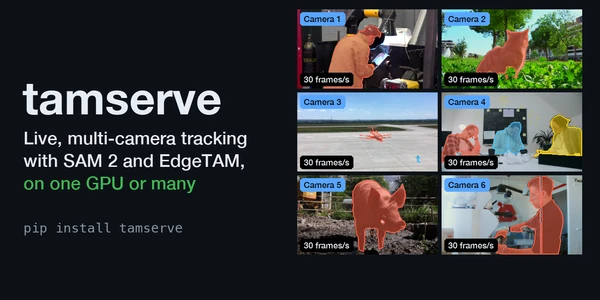
A developer published tamserve, an Apache-2.0 Python serving layer for SAM 2 and EdgeTAM that shares one model instance across live camera feeds instead of allocating a separate model for every stream. The repository contains executable camera-loop examples, tests, benchmarks, and recorded demonstrations. On the author's RTX 4090 tests, eight-camera EdgeTAM tracking consumed 2.2 GB of GPU memory versus 8.6 GB for the baseline, with similar segmentation accuracy. This is a practical architecture example for video analytics, robotics and streaming computer vision; the measurements have not been independently reproduced.

Publisher-provided image for tamserve: serving live multi-camera object tracking with shared GPU inference
Image: github.com
Source, examples and benchmarks
Read full briefing Collapse briefing

Detailed briefing

What the demonstration shows

The author documents live object masks across multiple camera streams and supplies a short recorded six-camera demonstration. An engine accepts frames from each stream and returns per-object segmentation masks, maintaining tracking state across calls. It supports box, click and mask prompts, with additional named-object tracking through a detector.

The serving architecture

The important idea is separating model serving from camera capture. Multiple streams share one GPU-resident model, and work can be batched rather than spawning a separate model per camera. The project includes code, tests and a benchmark directory; its comparison uses EdgeTAM on an RTX 4090 and reports substantial GPU memory savings. These are author-reported measurements, not independently reproduced results.

Reproduction and constraints

The documented Python API uses pip install tamserve and a frame-processing loop that passes the newest frame from each camera to engine.step(). The author recommends an NVIDIA GPU for live performance, though CPU experimentation is possible. Real-world results will depend on resolution, object count, camera count, decoding, GPU and tracking conditions.

Developer ToolsTechnical writeupblog.antonio.cx

lend: local approval for remote coding agents without sharing credentials

A November 13 technical writeup documents a remote-agent workflow using herdr, Ovis and lend. Claude Code and Codex run on remote virtual machines, while the developer keeps authenticated GitHub and cloud CLIs, SSH keys and 1Password credentials on a local laptop. A forwarded SSH-agent socket carries restricted command requests back to the laptop, where policy and biometric approval govern execution. The post includes concrete configuration, MCP integration, connection-recovery handling and a security analysis. It reduces credential copying but is not a sandbox for approved local commands.

Publisher-provided image for lend: local approval for remote coding agents without sharing credentials
Image: blog.antonio.cx
Hands-on technical walkthroughalso Source repository
Read full briefing Collapse briefing

Detailed briefing

The workflow

The author runs coding agents in disposable remote VMs and manages them through a terminal multiplexer and a browser or phone interface. Rather than copying credentials to the remote machines, lend forwards restricted requests through a proxy SSH-agent socket. The agent can request an authenticated GitHub CLI operation and receive the output after local approval.

Policies, MCP and reconnects

The writeup includes policy rules for executable paths, argument prefixes, SSH key fingerprints and approval requirements. Claude Code can call a local-command tool through lend's MCP server. A stable socket symlink is used so long-running agent sessions can recover after SSH reconnects. The author also documents leases, logs and hooks for remote permission prompts.

Threat model and caveats

Credentials remain on the laptop, but approved commands execute with the laptop user's permissions. Allowing a shell, interpreter or secret-printing command can defeat the intended boundary. Caller descriptions from the VM are untrusted, and anyone with access to the forwarded socket can submit requests subject to policy and approval. The tool is early-stage and its described security properties have not been independently audited here.

Developer ToolsInteractive demothingstudio.net

ThingStudio: visual flows and AI-generated MicroPython for microcontrollers

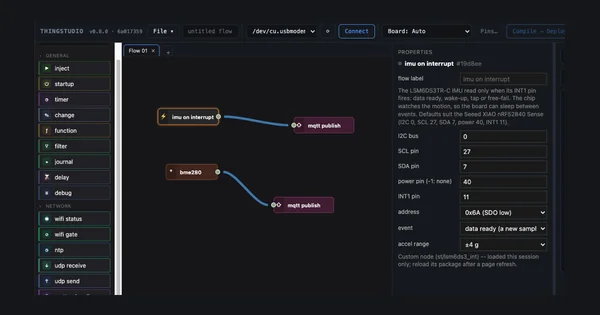
Mike Karliner demonstrated ThingStudio, an Apache-2.0 beta project that lets developers assemble event-driven microcontroller workflows visually and compile them into MicroPython. The site includes a browser demo, hardware examples and an AI-authoring approach: an assistant writes a structured flow, runs the compiler, corrects pin or node errors, and leaves a visual program a human can inspect. Supported targets include ESP32 and Raspberry Pi Pico families. Unlike a remote dashboard, the compiled flow runs on the board after deployment. Hardware coverage and usability are primarily maintainer-tested.

Publisher-provided image for ThingStudio: visual flows and AI-generated MicroPython for microcontrollers
Image: thingstudio.net
Interactive demo and technical overviewalso Browser editor demo
Read full briefing Collapse briefing

Detailed briefing

What the demonstration contains

The site demonstrates a blinking LED flow and lets readers try the visual editor in a browser without installing hardware tools. It also documents practical chains involving buttons, timers, sensors, MQTT and LEDs. Flow files are plain JSON, and the editor can compile them into MicroPython for deployment over USB or WiFi.

Why the AI workflow is different

Instead of asking an assistant for a monolithic script, the documented workflow asks it to produce a flow file using predefined nodes and connections. The compiler checks board definitions and pin conflicts, returning errors that can be corrected before deployment. The human can inspect the generated flow visually, which provides a reviewable intermediate representation between a natural-language request and device code.

Reproduction and limitations

The browser demo is available without an account; deploying to hardware requires a compatible MicroPython board and local setup. The author reports testing several ESP32, RP2040, RP2350, nRF52840 and STM32 boards. The project is explicitly beta, with incomplete independent hardware testing and potential rough edges in setup and documentation.