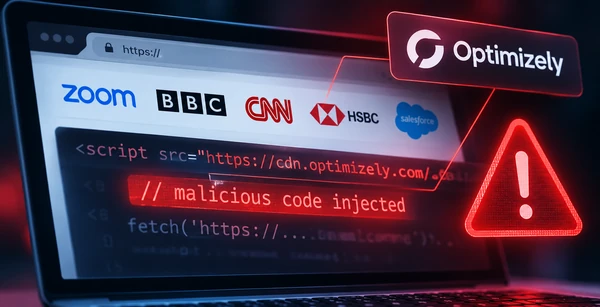
The most consequential November 16 development is a reported supply-chain attack involving Optimizely-delivered JavaScript used by at least 178 organizations.
Researchers described malicious payloads targeting cryptocurrency transactions, payment-card data and browser sessions; most observed scripts were removed, but the full impact remains uncertain. Separately, JPMorgan Chase reported a software defect that delayed transactions involving other banks, illustrating how a failure inside one institution can propagate through payment dependencies without those other banks experiencing independent outages. United Airlines resolved a separate departure-systems disruption, with no verified common cause linking these incidents. Beyond operations, US restrictions concerning overseas access to advanced AI computing, AMD's World Labs acquisition and Alibaba's Qwen4-Max announcement reflect ongoing shifts in infrastructure and model competition. Developer-relevant research includes a patched uBlock Origin vulnerability, Windows coding-tool telemetry observations and Jiff 1.0's stable Rust datetime API. No comprehensive new employment dataset establishes a broad change in senior software-engineering hiring.
Scott Helme identified 188 infected Optimizely Web snippets at 178 organizations on November 16, distributing cryptocurrency address substitution, payment-card skimming, cookie theft and iOS exploit payloads. Most observed scripts were cleaned by the final sweep; the full impact is unknown. The practical significance depends on the specific technical mechanism and the independently established scope, rather than headline counts or vendor claims. The remaining evidence gaps are important when assessing operational consequences.
Why it matters
Trusted third-party scripts can create cross-organization security exposure without direct compromises of each customer website.
The investigation describes malicious code delivered through a third-party experimentation script. Because websites load those scripts in visitors' browsers, an attacker can reach users of multiple unrelated organizations without separately altering each organization's application code.
Observed payloads and uncertainty
The reported behavior included cryptocurrency-address replacement, card skimming, cookie theft and mobile exploit delivery. The researcher reported 188 infected snippets across 178 organizations, but that is not a verified number of compromised visitors. Most observed scripts were cleaned; full exposure and initial access remain uncertain.
Limitations & caveats
Initial access and total affected visitors remain unknown. A separate Optimizely service incident is not proven related.
JPMorgan transaction delays affect other banks before restoration
JPMorgan's on-premises software bug delayed some transactions and interbank Zelle transfers on November 16. Chase reported normal processing Monday evening; other banks and Zelle said their systems remained operational. The practical significance depends on the specific technical mechanism and the independently established scope, rather than headline counts or vendor claims. The remaining evidence gaps are important when assessing operational consequences.
Why it matters
Cross-institution dependencies propagate a single provider's failure into customers' payment workflows.
JPMorgan attributed delayed transaction processing to an internal software defect in on-premises systems. Transfers involving JPMorgan could be delayed even when other banks' internal platforms and the Zelle network remained operational.
Recovery and lessons
Chase said customers retained access to funds, found no evidence of a cyberattack and subsequently reported normal processing. The detailed defect and total customer impact remain uncertain. Payment monitoring should distinguish bank uptime from the state of transactions crossing institutional boundaries.
Limitations & caveats
Exact root cause and affected population remain unclear; no shared cause with other outages is established.
The Commerce Department issued an interim rule addressing advanced AI chips accessed through overseas data centers, including additional licensing requirements in Singapore, Thailand, Malaysia, Indonesia and Brazil. The practical significance depends on the specific technical mechanism and the independently established scope, rather than headline counts or vendor claims. The remaining evidence gaps are important when assessing operational consequences.
Why it matters
Compute location and remote access become important compliance considerations for cloud providers and AI infrastructure operators.
The reported Commerce Department measure addresses remote access to advanced US AI accelerators through overseas data centers. That differs from rules concerned solely with shipping physical chips abroad.
Operational implications
Cloud providers may need to examine customer access, licensing and compute location. The specific exemptions and enforcement obligations depend on the rule text; it should not be interpreted as a universal ban on foreign GPU rentals.
Limitations & caveats
Implementation details and enforcement remain uncertain; the rule is not a blanket prohibition on all cloud compute.
AMD confirmed the World Labs acquisition on November 16; its SEC filing reports a November 13 closing. Fei-Fei Li joins as executive vice president and chief scientist. The practical significance depends on the specific technical mechanism and the independently established scope, rather than headline counts or vendor claims. The remaining evidence gaps are important when assessing operational consequences.
Why it matters
Spatial AI research could inform AMD accelerator and systems design beyond text generation.
AMD announced completion of its World Labs acquisition on November 16; the cited SEC filing identifies November 13 as the closing date. The company gains research leadership associated with spatial AI.
What remains to be demonstrated
Spatial AI involves geometry and representations of environments, with potential applications in robotics and simulation. The transaction does not itself establish shipping products, accelerator performance gains or commercial adoption.
Limitations & caveats
Commercial impact and spatial inference performance are not yet established.
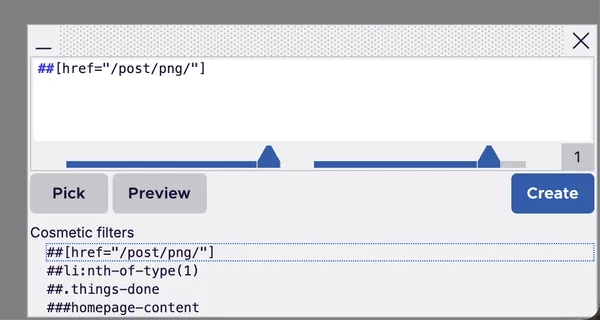
A Firefox Manifest V2 uBlock Origin element-picker vulnerability allowed malicious websites to trick users into adding trusted filters with script execution on other websites. It was patched. The practical significance depends on the specific technical mechanism and the independently established scope, rather than headline counts or vendor claims. The remaining evidence gaps are important when assessing operational consequences.
Why it matters
Browser extension UI must isolate untrusted website content from privileged configuration.
The disclosed Firefox Manifest V2 uBlock Origin vulnerability involved untrusted website content influencing a privileged element-picker configuration workflow. With user interaction, the flaw could lead to script execution across sites.
Status and practical response
The vulnerability was patched. The advisory does not establish widespread exploitation. Extension developers should treat page-derived input as untrusted, and users should keep the extension updated.
Limitations & caveats
Requires user interaction; no widespread exploitation established.
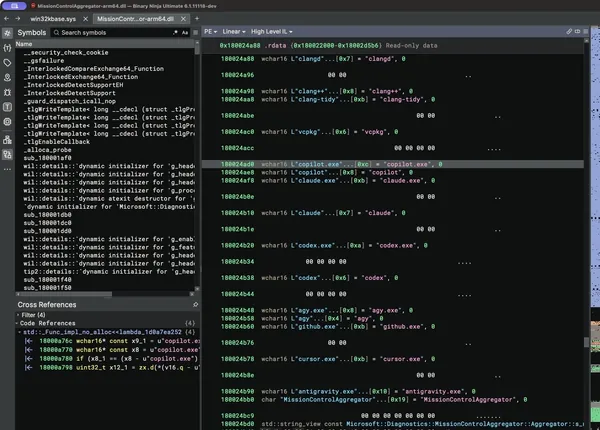
Reverse engineering found Windows diagnostics recording the presence of developer tools including Claude, Codex and Cursor. Optional diagnostics in tested configurations queued usage metadata for upload, without observed prompts or source code. The practical significance depends on the specific technical mechanism and the independently established scope, rather than headline counts or vendor claims. The remaining evidence gaps are important when assessing operational consequences.
Why it matters
Usage metadata may expose professional development workflows even when code content is not collected.
An independent Windows 11 investigation found diagnostic events indicating use of coding agents and developer tools, including Claude, Codex and Cursor, in tested configurations.
What was not shown
The report did not establish collection of prompts or source repositories, nor equivalent behavior on every Windows installation. Application-use metadata can still reveal development practices, so privacy-sensitive organizations should examine diagnostic settings and actual endpoint telemetry.
Limitations & caveats
Findings apply to specific tested builds and settings, not all Windows installations.
Alibaba announces Qwen4-Max with new security safeguards
Alibaba unveiled a 2.4-trillion-parameter flagship model, reporting improved secure-code results and lower task costs in its own tests; smaller open-weight Qwen4 variants are planned. The practical significance depends on the specific technical mechanism and the independently established scope, rather than headline counts or vendor claims. The remaining evidence gaps are important when assessing operational consequences.
Why it matters
Security-aware coding capabilities and competition from Chinese model providers are strategically important.
Alibaba announced Qwen4-Max as a flagship model with claimed improvements in secure-code generation and task economics. The cited performance figures are vendor-reported rather than independently reproduced.
How to evaluate it
Useful comparisons require realistic repository-level tasks, correctness and security outcomes, latency and cost per successful task. The flagship should not be labeled open source merely because other Qwen models distribute weights; licensing and training transparency are separate questions.
Limitations & caveats
Benchmarks and safety claims are company-reported; planned open weights are not a released open-source training stack.
Andrew Gallant released Jiff 1.0 November 15, with civil/zoned time representations and DST-safe calendar operations; it already has adoption in Cargo, uv and Nushell. The practical significance depends on the specific technical mechanism and the independently established scope, rather than headline counts or vendor claims. The remaining evidence gaps are important when assessing operational consequences.
Why it matters
Mature timezone handling reduces persistent production correctness risks.
Jiff 1.0 provides stable Rust APIs distinguishing civil calendar time from time tied to a zone. Calendar-day arithmetic can differ from adding 24 elapsed hours across daylight-saving transitions.
Migration considerations
The maintainer cites use in Cargo, uv and Nushell. Teams should test ambiguous local times, recurring schedules, serialization compatibility and timezone-data behavior before replacing existing libraries.
Limitations & caveats
Migration and timezone-data compatibility need assessment.
United Airlines resolves separate departure-systems outage
A technology failure delayed departing United flights for about an hour on November 16; the airline confirmed resolution, with no impact on airborne or United Express flights and no established link to the FAA incident. This is a scoped development rather than evidence of a broader industry trend; practical consequences depend on deployment, adoption and independently verified results.
A technology failure delayed departing United flights for about an hour on November 16; the airline confirmed resolution, with no impact on airborne or United Express flights and no established link to the FAA incident.
Interpretation and limitations
The reported development is worth monitoring, but the cited source does not establish every downstream outcome. Verify exact versions, access conditions and operational effects before relying on it in production or treating it as an industry-wide change.
Harmonic announced Rust support for formal verification against specified properties, with vendor-reported examples that require independent assessment. This is a scoped development rather than evidence of a broader industry trend; practical consequences depend on deployment, adoption and independently verified results.
Harmonic announced Rust support for formal verification against specified properties, with vendor-reported examples that require independent assessment.
Interpretation and limitations
The reported development is worth monitoring, but the cited source does not establish every downstream outcome. Verify exact versions, access conditions and operational effects before relying on it in production or treating it as an industry-wide change.
OpenCode Browse appeared in the HN front-page listings; evaluate its security boundaries and capabilities before production use. This is a scoped development rather than evidence of a broader industry trend; practical consequences depend on deployment, adoption and independently verified results.
OpenCode Browse appeared in the HN front-page listings; evaluate its security boundaries and capabilities before production use.
Interpretation and limitations
The reported development is worth monitoring, but the cited source does not establish every downstream outcome. Verify exact versions, access conditions and operational effects before relying on it in production or treating it as an industry-wide change.
US reportedly preparing AI national champions designation
A reported initiative could offer export support and financing to selected US AI companies; no final designation was verified. This is a scoped development rather than evidence of a broader industry trend; practical consequences depend on deployment, adoption and independently verified results.
A reported initiative could offer export support and financing to selected US AI companies; no final designation was verified.
Interpretation and limitations
The reported development is worth monitoring, but the cited source does not establish every downstream outcome. Verify exact versions, access conditions and operational effects before relying on it in production or treating it as an industry-wide change.
AI coding changes engineering collaboration expectations
Interviews with employers suggest greater emphasis on judgment, communication and customer context, but anecdotes do not establish an industry-wide hiring shift. This is a scoped development rather than evidence of a broader industry trend; practical consequences depend on deployment, adoption and independently verified results.
Interviews with employers suggest greater emphasis on judgment, communication and customer context, but anecdotes do not establish an industry-wide hiring shift.
Interpretation and limitations
The reported development is worth monitoring, but the cited source does not establish every downstream outcome. Verify exact versions, access conditions and operational effects before relying on it in production or treating it as an industry-wide change.
GitHub Copilot models scheduled for December retirement
GitHub will retire selected Copilot models on December 14; audit pinned model choices in coding workflows. This is a scoped development rather than evidence of a broader industry trend; practical consequences depend on deployment, adoption and independently verified results.
GitHub will retire selected Copilot models on December 14; audit pinned model choices in coding workflows.
Interpretation and limitations
The reported development is worth monitoring, but the cited source does not establish every downstream outcome. Verify exact versions, access conditions and operational effects before relying on it in production or treating it as an industry-wide change.
Organizations can manage AI Scan settings through APIs, useful for repository security policy automation. This is a scoped development rather than evidence of a broader industry trend; practical consequences depend on deployment, adoption and independently verified results.
Organizations can manage AI Scan settings through APIs, useful for repository security policy automation.
Interpretation and limitations
The reported development is worth monitoring, but the cited source does not establish every downstream outcome. Verify exact versions, access conditions and operational effects before relying on it in production or treating it as an industry-wide change.
Gemini 4 Hydrogen remains the newest confirmed Copilot model addition
The November 13 release targets fast agentic coding; no independently validated performance comparison was identified this morning. This is a scoped development rather than evidence of a broader industry trend; practical consequences depend on deployment, adoption and independently verified results.
The November 13 release targets fast agentic coding; no independently validated performance comparison was identified this morning.
Interpretation and limitations
The reported development is worth monitoring, but the cited source does not establish every downstream outcome. Verify exact versions, access conditions and operational effects before relying on it in production or treating it as an industry-wide change.
AI-agent workflow study finds prompt-injection defenses rarely specified
A September empirical paper analyzing 1,248 GitHub agentic-workflow files found explicit prompt-injection defenses in only 9.4% of labeled workflows; useful background, not a new release. This is a scoped development rather than evidence of a broader industry trend; practical consequences depend on deployment, adoption and independently verified results.
A September empirical paper analyzing 1,248 GitHub agentic-workflow files found explicit prompt-injection defenses in only 9.4% of labeled workflows; useful background, not a new release.
Interpretation and limitations
The reported development is worth monitoring, but the cited source does not establish every downstream outcome. Verify exact versions, access conditions and operational effects before relying on it in production or treating it as an industry-wide change.
tamserve: serving live multi-camera object tracking with shared GPU inference
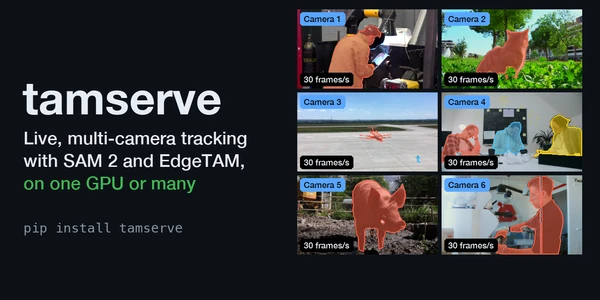
A developer published tamserve, an Apache-2.0 Python serving layer for SAM 2 and EdgeTAM that shares one model instance across live camera feeds instead of allocating a separate model for every stream. The repository contains executable camera-loop examples, tests, benchmarks, and recorded demonstrations. On the author's RTX 4090 tests, eight-camera EdgeTAM tracking consumed 2.2 GB of GPU memory versus 8.6 GB for the baseline, with similar segmentation accuracy. This is a practical architecture example for video analytics, robotics and streaming computer vision; the measurements have not been independently reproduced.
The author documents live object masks across multiple camera streams and supplies a short recorded six-camera demonstration. An engine accepts frames from each stream and returns per-object segmentation masks, maintaining tracking state across calls. It supports box, click and mask prompts, with additional named-object tracking through a detector.
The serving architecture
The important idea is separating model serving from camera capture. Multiple streams share one GPU-resident model, and work can be batched rather than spawning a separate model per camera. The project includes code, tests and a benchmark directory; its comparison uses EdgeTAM on an RTX 4090 and reports substantial GPU memory savings. These are author-reported measurements, not independently reproduced results.
Reproduction and constraints
The documented Python API uses pip install tamserve and a frame-processing loop that passes the newest frame from each camera to engine.step(). The author recommends an NVIDIA GPU for live performance, though CPU experimentation is possible. Real-world results will depend on resolution, object count, camera count, decoding, GPU and tracking conditions.
lend: local approval for remote coding agents without sharing credentials
A November 13 technical writeup documents a remote-agent workflow using herdr, Ovis and lend. Claude Code and Codex run on remote virtual machines, while the developer keeps authenticated GitHub and cloud CLIs, SSH keys and 1Password credentials on a local laptop. A forwarded SSH-agent socket carries restricted command requests back to the laptop, where policy and biometric approval govern execution. The post includes concrete configuration, MCP integration, connection-recovery handling and a security analysis. It reduces credential copying but is not a sandbox for approved local commands.
The author runs coding agents in disposable remote VMs and manages them through a terminal multiplexer and a browser or phone interface. Rather than copying credentials to the remote machines, lend forwards restricted requests through a proxy SSH-agent socket. The agent can request an authenticated GitHub CLI operation and receive the output after local approval.
Policies, MCP and reconnects
The writeup includes policy rules for executable paths, argument prefixes, SSH key fingerprints and approval requirements. Claude Code can call a local-command tool through lend's MCP server. A stable socket symlink is used so long-running agent sessions can recover after SSH reconnects. The author also documents leases, logs and hooks for remote permission prompts.
Threat model and caveats
Credentials remain on the laptop, but approved commands execute with the laptop user's permissions. Allowing a shell, interpreter or secret-printing command can defeat the intended boundary. Caller descriptions from the VM are untrusted, and anyone with access to the forwarded socket can submit requests subject to policy and approval. The tool is early-stage and its described security properties have not been independently audited here.
ThingStudio: visual flows and AI-generated MicroPython for microcontrollers
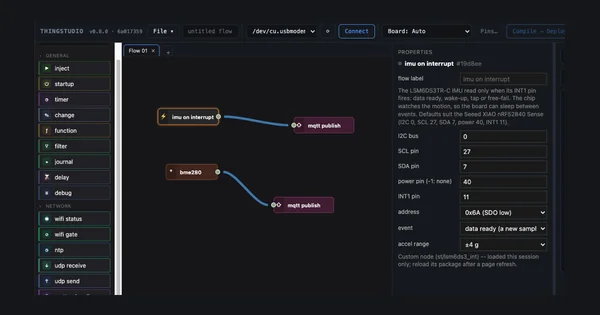
Mike Karliner demonstrated ThingStudio, an Apache-2.0 beta project that lets developers assemble event-driven microcontroller workflows visually and compile them into MicroPython. The site includes a browser demo, hardware examples and an AI-authoring approach: an assistant writes a structured flow, runs the compiler, corrects pin or node errors, and leaves a visual program a human can inspect. Supported targets include ESP32 and Raspberry Pi Pico families. Unlike a remote dashboard, the compiled flow runs on the board after deployment. Hardware coverage and usability are primarily maintainer-tested.
The site demonstrates a blinking LED flow and lets readers try the visual editor in a browser without installing hardware tools. It also documents practical chains involving buttons, timers, sensors, MQTT and LEDs. Flow files are plain JSON, and the editor can compile them into MicroPython for deployment over USB or WiFi.
Why the AI workflow is different
Instead of asking an assistant for a monolithic script, the documented workflow asks it to produce a flow file using predefined nodes and connections. The compiler checks board definitions and pin conflicts, returning errors that can be corrected before deployment. The human can inspect the generated flow visually, which provides a reviewable intermediate representation between a natural-language request and device code.
Reproduction and limitations
The browser demo is available without an account; deploying to hardware requires a compatible MicroPython board and local setup. The author reports testing several ESP32, RP2040, RP2350, nRF52840 and STM32 boards. The project is explicitly beta, with incomplete independent hardware testing and potential rough edges in setup and documentation.
04Job market & business pulse
Macro observations
No new comprehensive US software-engineering employment release establishes a change in senior or Staff+ hiring. AMD's World Labs acquisition signals strategic AI investment, while chip restrictions and financial stability risks complicate the business outlook. The day's supply-chain and banking incidents emphasize operational security and reliability, not a measured hiring trend.