Broadcom's November 19 VMware advisory leads today's security coverage: a critical vCenter authentication bypass has no workaround, and supported patches are available.
The European Commission also confirmed that an AI-assisted cyberattack detected October 22 disrupted internal applications; most have recovered, but the investigation and some restoration work continue. Neither incident has a verified connection to other recent outages.
PostgreSQL 19 is the most consequential developer-platform release, adding online table repacking, planner advice and read-your-writes support for replicas. Anthropic began Nasdaq trading after its record-sized IPO, while Google published unusually detailed production data about Sashiko, its Linux kernel AI code-review service.
The practical-tooling section emphasizes reproducible or inspectable work: Sashiko's independent verification passes, browser-based weight-space experiments, lightweight local transcription and a self-hosted voice-assistant walkthrough. Earlier NGINX, Java4Shell and Python package supply-chain incidents still warrant patch and credential review. No representative new Staff-level engineering hiring dataset was verified.
Broadcom issued VMSA-2026-0009 on November 19, patching five vulnerabilities across VMware vCenter, SDDC Manager and VMware Tools. The most urgent is CVE-2026-123890, a 9.8-rated VMware Directory Service authentication bypass that could let a network-reachable attacker obtain unauthorized vCenter access. Broadcom lists no workaround, making patched releases the primary defense.
The response matrix lists vCenter 8.0 U3m, 9.0.2.0200 and 9.1.1.0200 among fixed versions. Separate reporting says Google/Mandiant identified earlier exploitation by a suspected espionage actor, but the scale of compromise is not established.
Why it matters
A network-reachable management-plane authentication bypass can compromise control of an organization's virtual infrastructure.
vCenter controls virtualization hosts, virtual machines and administrative operations, so compromise of its authentication boundary can have effects beyond a single workload. Broadcom describes the vulnerable component as VMware Directory Service and specifies network access to the affected vCenter service as the prerequisite. The advisory also includes separate SDDC Manager SQL injection, command injection and privilege-escalation issues, plus a VMware Tools SAML signature bypass. These are distinct vulnerabilities and should not be conflated with the authentication bypass.
Fixed versions and response
Broadcom's November 19 response matrix lists fixes for vCenter 8.0 and supported 9.x and Cloud Foundation branches, with special support guidance for vCenter 7 under extended support. The critical authentication bypass has no published workaround. Operators should identify affected management appliances, restrict management-network exposure where possible, apply the exact vendor patch for their branch and review authentication and administrative activity for anomalies.
Exploitation and uncertainty
Google Threat Intelligence and Mandiant reportedly observed exploitation before public disclosure and described tooling associated with a suspected espionage actor. That account increases urgency but does not establish the number of affected enterprises. The first-party advisory confirms the vulnerability and remediation, not the broader campaign attribution. A detailed independent account of affected victims and completed patch deployments remains unavailable.
Limitations & caveats
The full scope of observed exploitation and patch adoption is unknown.
The European Commission confirmed November 19 that an AI-assisted cyber campaign detected October 22 prompted it to take several internal applications offline. Most services have been restored, but some tools remain unavailable, and the investigation is continuing. Officials confirmed misuse of AI tools without identifying the attacker or detailing how the intrusion occurred.
Politico reported possible exposure of personnel information and disruption to administrative systems, but the Commission has not corroborated those details. Its spokesperson said there was no evidence of a breach affecting Commission staff as a whole; that is not a guarantee that no individual records were exposed.
Why it matters
A major public institution confirms real service disruption and AI-assisted attacker activity, while data exposure remains under investigation.
The Commission says it detected the campaign on October 22 and launched an investigation and preventive shutdowns. It publicly confirmed the AI-assisted nature of the campaign November 19. The reported operational disruption lasted beyond the initial detection, but officials did not provide a complete per-application outage timeline. Publication date should not be confused with the incident's October occurrence.
Operational and data impact
Several internal applications were deliberately taken offline as a protective measure, and most were subsequently restored. Reports describe possible effects on translation, payroll, timesheets and reimbursement systems, but the Commission declined to confirm those specific systems. It also said it had found no evidence of a staff-wide data breach. The unknown number of affected individuals and remaining offline tools prevent a definitive blast-radius estimate.
What AI involvement establishes
Officials described the campaign as involving AI tools, but did not publish a reproducible technical chain or identify a particular agent or model. AI-assisted vulnerability discovery does not itself demonstrate autonomous end-to-end exploitation. The investigation is open, and claims about the attacker's identity, initial access and stolen records remain unverified.
Limitations & caveats
No verified attribution, technical entry point or comprehensive breach assessment.
The PostgreSQL Global Development Group released PostgreSQL 19 on November 19. The release adds `REPACK (CONCURRENTLY)` for reclaiming table bloat without blocking normal reads and writes, `pg_plan_advice` for influencing planner choices, and `WAIT FOR LSN` to support read-your-writes consistency on standbys. Developers also gain `INSERT ... ON CONFLICT DO SELECT` for get-or-create patterns and JSON output from `COPY`.
Other changes include parallel autovacuum index processing, improved replication behavior, more I/O observability and default JIT disabling. These are substantive operational improvements, but teams should benchmark workloads and validate extension compatibility before upgrading.
Why it matters
Core database maintenance and consistency improvements reduce downtime and application workarounds.
The new REPACK operation reclaims space and can reorder table data, while its CONCURRENTLY mode is designed to keep normal reads and writes available. This addresses a familiar tradeoff with VACUUM FULL and CLUSTER, which remain for compatibility. Autovacuum gains parallel index processing and workload-priority scoring, while additional statistics views expose locks, recovery and vacuum priorities.
Planner control and replica consistency
The pg_plan_advice extension provides a way to influence query plan selection and store advice for repeat use, helping teams respond to regressions without rewriting application SQL. WAIT FOR LSN lets a standby wait until it has replayed a specified write-ahead log position before a dependent read, addressing the classic lag-induced read-your-writes problem. Logical replication also gains sequence-value support and simpler WAL-level setup.
Developer ergonomics and migration considerations
INSERT ON CONFLICT DO SELECT returns an existing conflicting row, simplifying get-or-create round trips. COPY gains JSON output, window functions gain IGNORE NULLS, and foreign-key checks and NOT IN planning receive optimizations. JIT is now disabled by default because its cost estimation proved unreliable. Operators should test extension compatibility, SQL semantics, query plans, replication behavior and rollback procedures before production upgrades.
Limitations & caveats
A major-version upgrade still requires extension, compatibility and workload testing; vendor benchmarks are not universal.
Anthropic's shares began trading on Nasdaq November 19 under ANT following an approximately $81 billion IPO priced at $83 per share. Reuters reported the shares closed at $97.17, around 17% above the offer price, after a stronger opening. The company's public debut follows years of unusually large private capital commitments to frontier AI.
The milestone changes transparency and capital-market access, but does not resolve questions about model training expense, inference margins or future compute commitments. Broader technology stocks fell during the session despite the high-profile debut.
Why it matters
Public-market reporting exposes frontier-model economics and financing assumptions to broader scrutiny.
November 18 coverage established the $83 offering price and expected November 19 listing. Today's material update is that trading began and the first session closed at $97.17. The IPO raised roughly $81 billion, while valuation figures vary depending on whether outstanding or fully diluted shares are counted. Those distinctions matter when comparing the company with publicly traded peers.
Economics under public scrutiny
Anthropic's rapid enterprise and coding-tool growth is paired with significant infrastructure investment. Public financial disclosures can clarify how much revenue is recurring, what compute costs are borne by the company and how cash consumption evolves. Neither a large raise nor a strong first session proves that the cost of training and serving frontier models has become sustainable.
Broader market signal
Reuters reported broad US equity declines during the same session, including weakness in semiconductor and cloud names, despite enthusiasm around Anthropic's debut. Investors appear to be separating company-specific demand from uncertainty about AI infrastructure spending and valuations. First-day volatility is a poor predictor of long-run performance, and the market reaction should not be treated as a verdict on AI technology.
Limitations & caveats
First-day share movement is not evidence of durable AI profitability.
Google published a November 19 engineering account of Sashiko, its open-source Gemini-powered Linux kernel code-review system. It reports roughly 1,200 reviews daily across more than 100 mailing lists, with over 70 lists opting into review emails. The architecture separates specialist passes for different bug classes from independent verification of disputed findings and even questionable dismissals.
Google reports Sashiko citations in more than 2,000 mainline commits and 500 kernel CVEs this year. It also observed lower subsequent fix rates after rollout, while explicitly cautioning that many other factors could explain the change.
Why it matters
A deployed AI review system offers rare operational measurements and a reproducible architecture for validating code changes.
Sashiko gathers code around a proposed diff, including relevant callers, structures and subsystem notes, then launches up to seven focused review sessions. They separately investigate intent, control flow, resource lifetimes, locking, security and hardware interactions. Each records not only suspected defects but also concerns it investigated and dismissed. A lead verifier audits both lists and sends ambiguous claims to independent per-bug verification agents, requiring code evidence rather than speculation.
Production data and developer feedback
Google says the system completes around 1,200 reviews a day, with more than 1,500 kernel developers having replied to its reports. It cites more than 2,000 mainline commits and over 500 CVEs that mention Sashiko. The reported 60-day follow-up fix rate fell from a historical 3.4% to 2.2% for a later release, but this before/after comparison is observational. Changes in release mix, review culture and reporting practices may contribute.
Reproduction and engineering implications
The project is open source, with review traces and prompts made public. Its most transferable design principle is to require independent evidence for both positive bug findings and dismissals, rather than treating model confidence as proof. Running similarly deep reviews can be costly: Google funds the public service, and the system averages extensive repository tool use. It complements rather than replaces experienced maintainers.
Limitations & caveats
Reported outcome correlations are not causal proof that the agent reduced bugs.
CISA flags exploited LiteLLM and legacy software vulnerabilities
CISA added four vulnerabilities to its Known Exploited Vulnerabilities catalog November 18, including a LiteLLM sandbox escape, Apache Axis, REDCap and Synology flaws. Inclusion reflects evidence of exploitation, not a shared attacker or a common incident.
LiteLLM operators should review exposure of the custom-code guardrail testing endpoint and the project's patched version guidance. The affected endpoint is especially relevant to organizations centralizing access to AI models.
The reported LiteLLM flaw involves escaping a Python sandbox through custom guardrail testing functionality. The other entries affect older Java web services, a research-data platform and NAS software. They represent distinct technical conditions and require product-specific patch decisions.
Prioritization
A KEV entry is a stronger exploitation signal than an unexploited CVE score, but it does not provide a victim count. Teams should prioritize internet exposure and sensitive credentials, verify vendor fixes and review suspicious access logs.
Anthropic reports AI-assisted progress on two black-hole physics problems
Anthropic published a technical account of Claude Fable 5.2 assisting with two theoretical-physics problems, including a calculation related to the Hawking–Page transition and an exact bound in a simplified modular-bootstrap setting. The work used multiple agent sessions and independent checks, and the company links research preprints.
One mathematical result was formally checked with Lean, according to the authors. These are bounded results in theoretical models, not proof of a general solution to quantum gravity.
Anthropic describes parallel agents exploring numerical patterns, relevant literature and analytical methods, with cross-checks and physicist review. One agent's spectral-curve observation became the basis for a proof of an optimal bound in the chosen modular-bootstrap setting.
Evidence and scope
The account links preprints and reports Lean verification for part of the work. Expert peer scrutiny and replication remain important, and the results apply to specific mathematical formulations rather than all physical black holes.
Google demonstrates Gemini 4 Neon applications in Blender and WebGL
Google's Gemini 4 Neon release article includes concrete demonstrations of an agent operating Blender through MCP, generating a WebGL2 ski simulator and constructing a spreadsheet image effect using formulas rather than embedded pictures. These examples are more informative than benchmark charts because they expose the kinds of multi-tool artifacts the company is testing.
They remain vendor demonstrations. Complete reproducibility, costs, iteration counts and independent verification are not established in the reviewed article.
Google describes a Blender lab-bench scene, a terrain-based WebGL ski simulator with custom shaders and a large formula-driven spreadsheet visual. The projects span 3D asset construction, browser rendering and spreadsheet computation.
How to evaluate them
The relevant evidence is the artifact, code and iteration history, not a model's assertion that it completed the task. Developers should inspect geometry, correctness, frame performance and cost before extrapolating to production workflows.
European AI security debate intensifies after official incident confirmation
European security officials are warning that AI tools can shorten the time required to discover and exploit vulnerabilities. The European Commission's newly confirmed October incident supplies an operational example, but published accounts do not yet establish the exact tooling, exploit chain or scope.
The broader concern is defensive response time: patching, asset inventory and change management become more difficult as attackers automate discovery. Claims that AI patching caused unrelated recent outages remain unsupported.
Germany's cybersecurity agency reported increasing attack pressure and faster exploitation timelines, while the European Commission confirmed misuse of AI in its own October cyber incident.
What is not established
No evidence reviewed connects the recent unrelated cloud, banking, aviation or infrastructure incidents to a common AI-driven patching failure. Security trends should not be used as a substitute for individual incident root-cause analysis.
Sashiko: open agent code review with independent bug verification
Google's Sashiko is a working open-source Linux kernel review service, not a product mockup. It runs focused parallel reviews for resource lifetimes, locking, security and other bug classes, then independently verifies both findings and suspicious dismissals. The public service exposes prompts, tool calls and reasoning traces, making it unusually inspectable.
Google reports approximately 1,200 daily reviews and substantial maintainer interaction. The published measurements are observational and the service's large token budget may limit independent replication.
A Gemini-backed reviewer processes real kernel mailing-list patches and emits maintainers' style review messages. It runs on an opt-in basis across dozens of lists and provides publicly inspectable evidence trails.
How to adapt the architecture
The distinctive pattern is to split concern discovery from verification. Each specialist investigates one bug class and logs rejected hypotheses; an independent agent checks contested claims and dismissals against repository code and call sites. Teams can adopt this architecture without claiming Google's production metrics.
Limitations
The public service is funded by Google and uses substantial tool calls per review. Historical changes in fix rates are correlations, not controlled evidence of a causal effect. Human maintainers remain essential.
Weight-Space Playground: inspect model-weight edits through WebGPU
A Show HN project demonstrates experiments in which one model modifies another model's weights, with a browser interface using WebGPU to make the process inspectable. The project is an unusual alternative to conventional prompting and fine-tuning demonstrations because it focuses on direct parameter-space manipulation.
It is a research-oriented visualization, not evidence that automated weight editing scales to large production models. Browser GPU support and available hardware can affect the experience.
The interactive page is designed to show model behavior changing as weight-space edits are applied. Readers can inspect the visualization and the surrounding explanation rather than relying on a generated performance claim.
Practical relevance and caveats
The demonstration is useful for understanding the distinction between editing weights and changing inference prompts. It does not establish general transfer to larger architectures or safe production deployment; the result is exploratory.
Starbright demonstrates a small, roughly 15 MB speech-to-text model that can run on the user's device through a browser interface. The key design choice is local inference rather than uploading every recording to a remote transcription service.
The project is useful for evaluating lightweight voice input in offline-capable applications. Its size does not establish accuracy across accents, noisy rooms or long recordings, and those conditions should be tested directly.
Open the browser demonstration, allow microphone input when desired and compare transcription behavior on representative short recordings. Its privacy claim depends on the actual runtime and network behavior, which was not independently audited in this review.
Engineering tradeoffs
A small client-side model may offer low latency and reduced data transfer at the cost of recognition quality and device compatibility. Benchmarking should include noise, languages, CPU/GPU support and battery use.
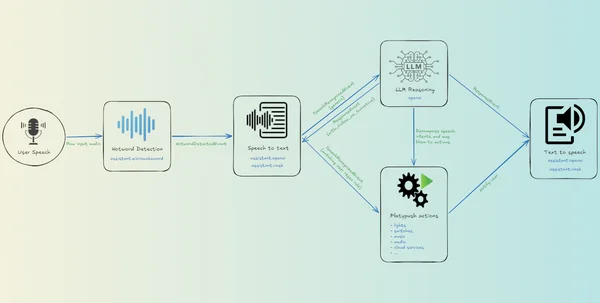
A developer's detailed walkthrough reconstructs a self-hosted voice-assistant pipeline, describing the choices involved in speech capture, recognition, command routing and response delivery. It is a practical counterpoint to cloud-only voice products: components can be swapped and profiled independently.
The value is in the engineering process and tradeoffs, not an independently measured claim that local assistants universally outperform hosted ones. Hardware, model choice and room acoustics affect results.
The author documents the design of a local voice workflow and its integration points. The article provides a concrete starting point for comparing recognition and command-handling components rather than treating voice interaction as a single black box.
How to use the walkthrough
Read the pipeline description, identify the stages and substitute locally available components before measuring end-to-end latency and error rates. Exact hardware and software requirements should be taken from the original article; this briefing does not claim to have reproduced the setup.
04Job market & business pulse
Macro observations
Anthropic's first Nasdaq session ended above its $83 IPO price, but the broader technology market fell. The record financing increases scrutiny of frontier AI revenue quality, inference margins and committed compute spending rather than establishing sustainable profitability.
No new representative November 19 dataset was verified showing a material change in senior or Staff+ software-engineering hiring or compensation. The Sashiko case study provides useful evidence of agent-assisted code review in production, but should not be interpreted as an employment forecast.